





The emergence of new respiratory infectious diseases continues to highlight the need for innovative vaccination strategies. In France, twelve multidisciplinary research teams based across four sites in Lille, Paris, Saint-Étienne and Tours are joining forces through the NAVIX project to develop and evaluate a new generation of nasal vaccines designed to act directly at the entry point of respiratory pathogens.
Coordinated by Dr Nathalie Mielcarek, Inserm Research Director and Deputy Director of the Lille Center for Infection and Immunity (CIIL), the four-year programme benefits from €14 million in funding.
NAVIX – Nasal Vaccination against Pathogen X – is supported by the French State under the France 2030 investment programme, as part of the France Vaccins initiative, led by the Health Research Programme Agency and funded by the French National Research Agency (ANR).
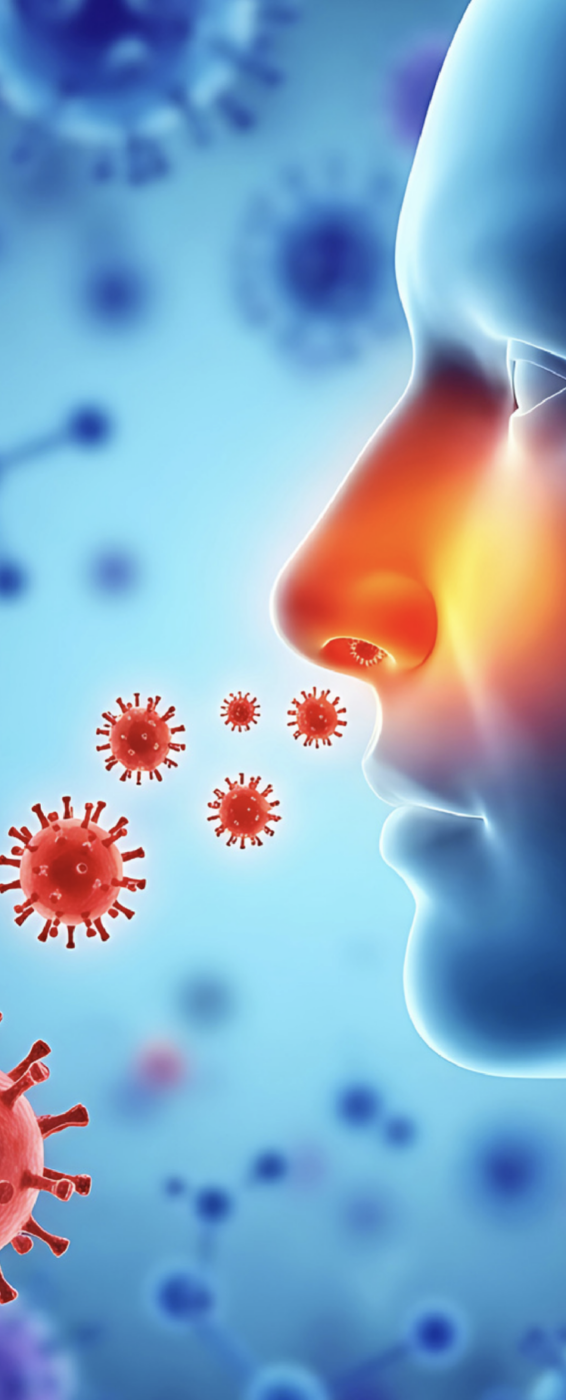
Targeting respiratory infections at their point of entry
The Covid-19 pandemic highlighted the importance of having new vaccination strategies available to respond rapidly to the emergence and spread of respiratory infectious agents.
While intramuscular vaccines provide effective protection against severe forms of many diseases and reduce symptoms, their ability to prevent infection at the level of the respiratory mucosa remains limited. These mucosal surfaces represent the first point of entry for many viruses and bacteria.
Nasal vaccination offers an alternative approach by stimulating immune defences directly within the respiratory tract. The objective is to block the initial stages of infection and help reduce pathogen transmission.
Developing tomorrow’s vaccine platforms
NAVIX aims to develop and evaluate several technologies for nasal vaccine administration.
Some approaches will rely on highly immunogenic recombinant antigens, designed and produced by the team led by Dr Isabelle Dimier-Poisson at the University of Tours. These will be combined with systems such as muco-excipients to improve delivery and retention at the mucosal surface.
Other strategies, developed by Dr Stéphane Paul’s team at the International Center for Infectiology Research (CIRI), will use an attenuated metapneumovirus as a vector to deliver antigens directly into the respiratory tract. A further approach will involve antigens conjugated to mucosal secretory antibodies, with the aim of improving their delivery and strengthening the resulting immune response.
Influenza will serve as the first model for testing these approaches. The longer-term objective is to develop vaccine platforms that can be adapted to other respiratory infectious agents, particularly emerging pathogens.
Strengthening the immune defences of the respiratory tract
To optimise the effectiveness of future nasal vaccines, NAVIX will use the high-throughput screening platform at the University of Lille to identify new molecules with potential adjuvant properties. These molecules could strengthen the immune response induced by vaccination within
the respiratory system.
The project will also draw on expertise developed at the Institut Pasteur de Lille around flagellin, a nasal adjuvant that has been extensively studied by its research teams. Its efficacy in humans will be evaluated in healthy volunteers, in collaboration with clinical teams.
In parallel, researchers led by Dr James Di Santo at the Institut Pasteur in Paris will investigate the role of the nasal microbiota in the mucosal immune response.
A national research network covering every stage of development
Over the next four years, the NAVIX teams will work across all the stages required to develop these new approaches, from vaccine candidate design and formulation for nasal administration to the assessment of their ability to induce an immune response and prevent pathogen transmission.
The research will also take into account key factors that may influence vaccine responses, including age, chronic respiratory inflammation such as chronic obstructive pulmonary disease (COPD), and the genetic variability of the host.
Another important aspect of the programme will be the development of new experimental models that more closely reproduce human respiratory tracts and their interactions with other organs. These will include organoids and organ-on-chip systems, providing tools to better understand and evaluate the responses triggered by future vaccine candidates.
The programme brings together the expertise of the Institut Pasteur de Lille, Institut Pasteur in Paris, the University of Tours, the University of Saint-Étienne, Inserm, the University of Lille, Lille University Hospital (CHU), CNRS, INRAE and Claude Bernard Lyon 1 University. Their combined capabilities cover vaccination, immunology, microbiology, virology, and preclinical and clinical evaluation.
As project coordinator Dr Nathalie Mielcarek explains, the teams have already been working for several years on new nasal vaccination approaches. NAVIX represents a further step by bringing together complementary expertise to develop and compare several vaccine platforms.
With influenza as the first research model, the ambition is to identify solutions that could subsequently be adapted to other respiratory infectious agents, including emerging pathogens.