



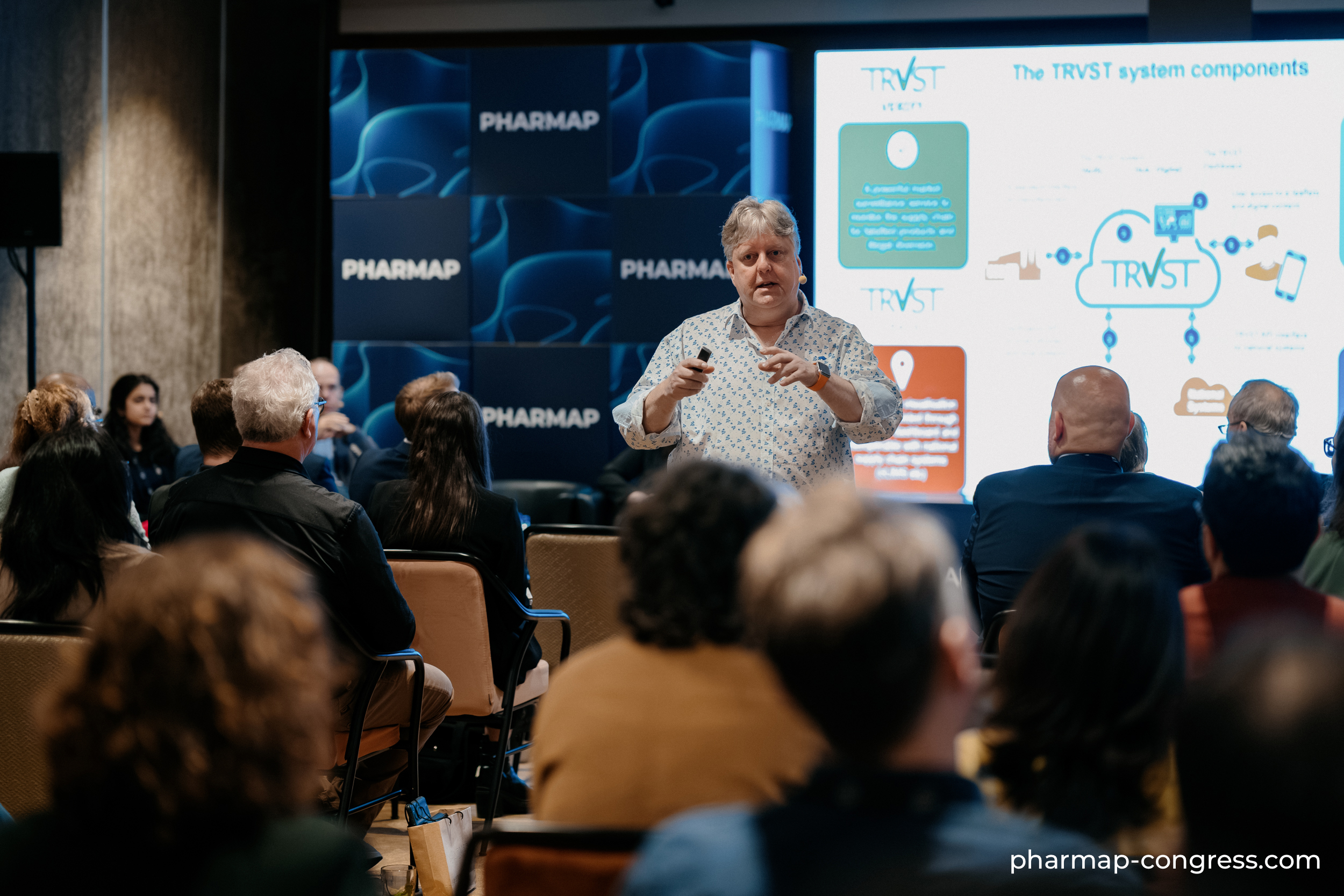
Bayer, Esteve, Roche and 180+ most influential decision-makers of European pharma gathered on 20-21 April in Amsterdam for the 6th edition of PHARMAP Congress. The event focused on the topics currently shaping the sector: Pharma 5.0, outsourcing, continuous manufacturing, sustainable packaging, AI-driven operations, patient centricity and practical case studies from leading pharma companies.
PHARMAP 2026 was supported by Astellas Pharma Europe B.V., GSK, ESTEVE, Laboratoires Théa and Recipharm as Regional Partners, reinforcing the event’s role as one of the key European platforms for pharmaceutical dialogue.
Making Pharma Connected
European pharma is operating in a period of intense transformation. Companies are balancing AI-driven precision, supply chain resilience, personalised medicine, ESG goals, regulatory pressure and financial constraints – often all at once.
For many organisations, the challenge is no longer only about finding the right technology or internal process. It is also about finding the right partners. Outsourcing, strategic collaboration and long-term supplier relationships are becoming essential parts of pharma’s operational model with 67% of pharma companies now outsourcing their operations.
PHARMAP 2026 placed this industry imperative front and centre with a dedicated Leaders Talk on forging win-win partnerships. Ulrich Rümenapp, Senior Biotech Program Lead at Bayer, shared Bayer’s strategic approach to outsourcing CMC development and GMP manufacturing of biologics, while Sebastian Mueller, Director Specialised Business Development at Vetter Pharma, explored the evolution from transactional vendor to long-term value creator in injectables partnerships.
This urgency for reliable partnerships made PHARMAP one of the key networking events in the pharmaceutical sector, with over 220 facilitated B2B meetings across two days, helping pharma specialists connect around practical operational challenges.
“There are quite a lot of companies, and it is good to meet companies that are of particular interest to us. There is a team here that works really hard to make that happen – they introduce and bring to us the people we need to see or take us to meet them” – Simon Cavanagh, Strategic Accounts Executive, Pharmaceutical at Esko.
Rethinking Pharma Packaging for Patients
Beyond operational partnerships, PHARMAP 2026 turned a sharp focus to the physical interface between patients and products – packaging. With the Packaging and Packaging Waste Regulation (PPWR) reshaping sustainability mandates and patient centricity driving usability demands, the industry is rethinking packaging as a critical touchpoint. The Congress brought together a wide audience of pharma packaging experts – heads of artwork and packaging development, packaging engineers, directors of packaging and labelling to provide a clear overview of the next steps in pharmaceutical packaging.
One of the key messages came from Simon Pickard, Human Factors Director at AstraZeneca UK Ltd, who positioned human factors as the missing link in packaging innovation. His presentation highlighted that true patient-centric design must go beyond the device itself. Packaging, instructions for use and digital touchpoints should not be treated as separate elements, but as one integrated user interface.
In this context, tactile cues, clear labelling, QR codes and app-based guidance can work together to reduce cognitive load, support correct use and prevent errors.
Artificial Intelligence was also discussed as a tool for making pharma packaging more inclusive. Zaida Navarro, Packaging Material Engineer at Ferrer, shared how Ferrer has begun working with optical character recognition technology to support smart, personalised packaging. By adapting how information is presented or accessed digitally, packaging can become easier to use for patients with low vision, cognitive challenges or language barriers.
Navarro also stressed that inclusive packaging should consider Braille, raised symbols, large fonts, bright colours and intuitive opening mechanisms – with AI helping to scale these adaptations more intelligently.
Meeting Pharma Sustainability Deadline
While patient-centric packaging addresses the usability of pharma products, the materials are being rewired by regulations. With the WHO establishing new standards and guidance for sustainable manufacturing and packaging and PPWR demanding all materials to be recyclable by 2030, the deadline for a green industry is nearing.
To move sustainability from a slide deck to the production line, PHARMAP 2026 dedicated a Panel Discussion on “Driving Sustainability in Pharma: Strategies for a Greener Tomorrow”.
Jürgen Bodenmüller, Director of Business Development at SÜDPACK Medica AG, shared concrete success stories from the transition to a circular and bioeconomy in pharma. He presented SÜDPACK’s advanced mono-PE film for pharmaceutical applications, a breakthrough that delivers PA/PE-like mechanical performance while supporting full recyclability. Crucially, this film is formulated with high focus on eliminating UV stabilisers, slip/antistatic agents, amide-based additives, magnesium-based antiblock additives, BHT and animal-derived calcium stearates.
Complementing the packaging focus, Carlos García, Global EHS Governance Manager at ESTEVE, shifted the lens to manufacturing’s broader environmental footprint as the healthcare sector is responsible for 5% of global emissions. García stressed that while 50% of top pharma companies have declared net-zero commitments, the real “ghost in the room” remains Scope 3 emissions. The solution is moving beyond aggregated corporate reporting to Product Carbon Footprint (PCF) metrics, which provide the granularity needed to guide R&D, operations and procurement decisions. The message was clear: design lower-carbon products from the start, change how processes are run even when that means regulatory adaptation, make sustainability a binding requirement in contracts and sourcing and reward faster action rather than penalising early movers.
The panel showed that pharma sustainability has moved beyond pilot projects. The next stage is scaling circular packaging, product-level decarbonisation and lower-carbon decision-making across entire portfolios.
Scaling Smart Manufacturing – AI, Digital Twins, Serialisation
Pharmaceutical companies in Europe are facing significant hurdles in digitalising their manufacturing processes, with studies indicating that 73% of digital transformations fail. To equip pharma with the right technologies and expertise, PHARMAP 2026 united IT specialists, quality leaders and manufacturing executives in a focused technology showcase that moved the conversation from theory to practice.
At the Focus Exhibition, Ample Logic took centre stage with live demos of digital Quality Management Systems (QMS), Continued Process Verification (CPV) and Annual Product Quality Review (APQR) platforms. Participants saw firsthand how AI-driven automation can streamline quality operations, reduce manual oversight, and ensure continuous compliance – turning regulatory obligations into competitive advantages.
Identiv showcased the cutting edge of smart packaging and traceability with live demonstrations of NFC, HF, BLE and UHF innovations. From near-field communication tags that authenticate products and engage patients via smartphone, to ultra-high frequency RFID enabling real-time inventory visibility across global supply chains, the demos proved that intelligent packaging is no longer a concept – it’s deployable today.
Together, these technologies are building the foundation of Pharma 5.0: a fully connected, intelligent and resilient industry. AI handles the complexity of data, digital twins simulate the consequences of every decision and serialisation ensures that every product is authentic, traceable and safe.
Looking ahead: PHARMAP 2027 in Berlin
The main question across PHARMAP 2026 was not whether European pharma needs to transform. The question was how to make this transformation practical, scalable and sustainable. With PPWR deadlines approaching, AI reshaping operations and geopolitical tensions, the industry needs more than theory – it needs validated, scalable solutions.
PHARMAP 2026 equipped pharma leaders with these actionable strategies as procurement specialists, manufacturing experts, packaging leads, data professionals and quality executives left Amsterdam with new partnerships, tested roadmaps and technology implementation plans.
The success of the 6th edition – over 220 B2B meetings and 45+ expert presentations featuring proven case studies – has set a new benchmark. With that, PHARMAP moves to Berlin in 2027.
On 19–20 April 2027, the German capital will host the next edition of PHARMAP, bringing the European pharma community together once again. The Congress will build on the strongest outcomes of the Amsterdam edition, scale proven cases and address the next wave of challenges in pharmaceutical manufacturing and packaging. The event will be hosted with the support of GSK as a Regional Partner and Bayer AG as the Official Host Sponsor. Early commitments have also come from allpack group, NTC Pharma, RidNova Pharmaceuticals, SÜDPACK Medica AG and other industry players.
Registration for PHARMAP 2027 is already open. Join key pharma decision-makers in Berlin on 19–20 April 2027 and be part of the conversations shaping the future of European pharmaceutical manufacturing and packaging.